Y.T. 1495-1496
The Darkening of Valinor

Today’s events
Y.T. 1495
This is a big one!
The yearly harvest festival is held on Taniquetil, and all the Vanyar and Noldor come; except for Finwë, who remains in Formenos in protest of Fëanor's exile. Fëanor is summoned, but leaves the Silmarils in Formenos; Fingolfin reconciles with him, which Fëanor accepts grudgingly.
While everyone is at the festival, Ungoliant and Melkor destroy the Two Trees. This is the Darkening of Valinor.
Yavanna says that if the Silmarils were broken and their light released, she could use them to restore the Trees, if it is done soon. The Valar request the Silmarils of Fëanor, but he refuses, and they accept his refusal.
Messengers arrive from Formenos with news that Melkor came there with a terrible Darkness. He killed Finwë, who alone had not fled from the horror of the Dark, and stole the Silmarils and all other gems that were in Formenos. Fëanor curses Melkor, naming him Morgoth, the Dark Enemy of the World, and flees into the night in desperate grief for his father.
Morgoth, aided by Ungoliant, escapes the pursuit of Tulkas and Oromë and escapes to the north across the Helcaraxë, the Grinding Ice, returning to Middle-earth. Ungoliant demands treasure to devour, and Morgoth grudginly gives her the gems from Formenos, except for the Silmarils. When she demands the Silmarils he refuses them, and she attacks him; but Morgoth cries out and Balrogs from from Angband to rescue him.
Ungoliant flees, and for a time lives in Nan Dungortheb, the valley north of Doriath, and makes it a place of horror; but the power of Melian keeps her out of Doriath. Morgoth rebuilds Angband, and raises the three peaks of the huge volcano of Thangorodrim above it, with many Orcs and other evil creatures. He forges himself a great Iron Crown, and places the Silmarils in it; but his hands are terribly burnt from the holy gems, and remain so for ever, and he can no longer change his shape.
The Noldor return to Tirion, and Fëanor comes there, breaking his banishment, and gives a speech claiming the kingship and calling the Noldor to return to Middle-earth and win freedom and great realms for themselves; and many of the Noldor are inspired by these words. Fëanor and his sons swear a terrible oath to retrieve the Silmarils, invoking Eru and Manwë and Varda, swearing to pursue with vengance any person “great or small, good or evil” who keeps a Silmaril from them. Fingolfin and his son Turgon speak against Fëanor because of the Oath, and Finrod son of Finarfin, a close friend of Turgon, is in agreement with them. Finarfin tries to calm everyone down, without success; his son Orodreth is the only one of his children who agrees with him in this. Fingon son of Fingolfin, and his close friends Angrod and Aegnor sons of Finarfin, as well as Finarfin's daughter Galadriel, desire to go to Middle-earth because of Fëanor's words, though they do not like him; but they keep their opinions to themselves and do not openly disagree with their fathers. After long debate Fëanor wins the argument, and he tries to get the Noldor moving as fast as possible before they can change their minds.
When the Noldor set out, Fëanor finds that the majority of them want Fingolfin as their king, so the Noldor set off in two divided groups. Fingolfin does not particularly want to go, but does so because Fingon urges him and because he does not want to leave behind his people, or leave them to the rash counsels of Fëanor; and because he committed at the festival to follow where Fëanor led. Finarfin goes for similar reasons, but is the least willing to go. One-tenth of the Noldor choose to remain in Tirion.
As the Noldor are departing, a messenger of the Valar advises and cautions them not to go, but says that the Valar will not hinder them in they choose to do so.
Fëanor leads the Noldor northwards at first, but then realizes they will need ships to cross the Sea, and goes to Alqualondë. He speaks there as he did in Tirion, but the Teleri are unmoved; they do not wish to depart, and they would rather dissuade the Noldor from doing so than help them leave, and they will not give them the swan-ships that Fëanor demands, the great work of their people: in the words of King Olwë of Alqualondë, “These ships are to us as are the gems of the Noldor: the work of our hearts, whose like we shall not make again.” Fëanor withdraws and considers, and then leads his people to try to take the ships by force; the Teleri resist them and throw many of the Noldor into the sea, and the Noldor draw their swords and attack the Teleri. The Teleri are far more lightly armed, with only small bows, but they are also more numerous, and Fëanor's side is losing until Fingon son of Fingolfin and his forces join the battle on their side. Then a large the Teleri are killed by the Noldor, and the Noldor steal the ships. This is the First Kinslaying - the first time elves have killed other elves.
Y.T. 1946
Mandos appears before the Noldor as they journey north and issues the Doom of the Noldor, laying out the consequences of the Kinslaying and the Oath. Finarfin with many of his people repent and return to Valinor, where they are pardoned by the Valar, and Finarfin becomes king of the remaining Noldor in Tirion. All of Finarfin's children continue on the Flight of the Noldor, and Finrod becomes the leader of those of Finarfin's people who go with them.
The Oath of Fëanor
Be he foe or friend, be he foul or clean,
brood of Morgoth or bright Vala,
Elda or Maia or Aftercomer,
Man yet unborn upon Middle-earth,
neither law, nor love, nor league of swords,
dread, nor danger, not Doom itself,
shall him defend from Fëanor, and Fëanor's kin,
whoso hideth or hoardeth, or in hand taketh,
findeth or keepeth or afar casteth
a Silmaril. This swear we all:
death we will deal him ere Day's ending,
woe unto world's end! Our word hear thou,
Eru Allfather! To the everlasting
Darkness doom us if our deed faileth.
On the holy mountain hear in witness
and our vow remember, Manwë and Varda!
(Morgoth’s Ring, p112)The Doom of the Noldor
Tears unnumbered ye shall shed; and the Valar will fence Valinor against you, and shut you out, so that not even the echo of your lamentation shall pass over the mountains. On the House of Fëanor the wrath of the Valar lieth from the West to the uttermost East, and upon all that will follow them shall it be laid also. Their Oath shall drive them and yet betray them, and ever snatch away the very treasures that they have sworn to pursue. To evil end shall all things turn that they begin well; and by treason of kin unto kin, and the fear of treason, shall this come to pass. The Dispossessed shall they be for ever.
Ye have spilled the blood of your kindred unrighteously and have stained the land of Aman. For blood ye shall render blood, and beyond Aman ye shall dwell in Death's shadow. For though Eru appointed you not to die in Eä, and no sickness may assail you, yet slain ye may be, and slain ye shall be, by weapon and by torment and by grief; and your houseless spirits shall come then to Mandos. There long shall ye abide and yearn for your bodies, and find little pity though all whom ye have slain should entreat for ye. And those that endure in Middle-earth and come not to Mandos shall grow weary of the world as with a great burden, and shall wane, and become as shadows of regret before the younger race that cometh after. The Valar have spoken. (The Silmarillion, Chapter 9, “Of the Flight of the Noldor”)
Family Trees
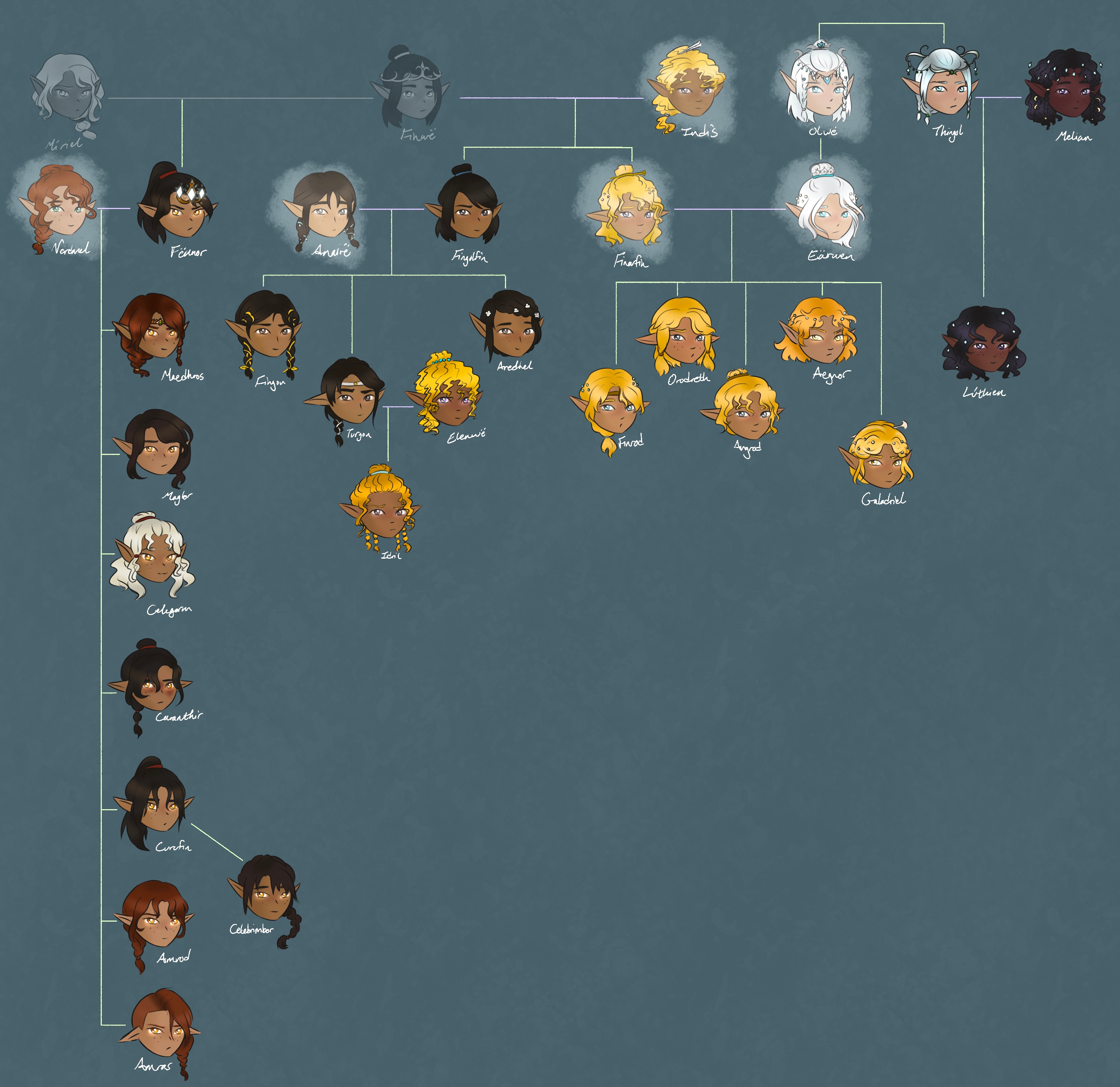
Today’s family tree debuts a new feature: an overlay indicating characters who have remained in Aman rather than join the exile of the Noldor into Middle-earth.